

What Is Attendance Logistics
and Why Does It Matter for Corporate Events?
There is a category of corporate event problem that doesn't get talked about clearly.
It isn't the venue that underdelivers. It isn't the keynote that runs long. It isn't the catering that misses the mark.
It is the guest who stood in a queue for 22 minutes at registration because the check-in system had a version of the guest list that was 4 days out of date. It is the delegate who didn't receive their transfer details because the update never made it from the email thread to the master document. It is the VIP who arrived at the hotel to find their room wasn't ready, and nobody on the event team had a single point of contact to escalate to.
These problems share a source.
That source is unmanaged attendance logistics.
So what exactly is attendance logistics?
Attendance logistics is the operational discipline of managing everything that connects a guest to a corporate event.
Not the event itself. Not the programme, the creative direction, the entertainment, or the production. Those elements are the event manager’s domain.
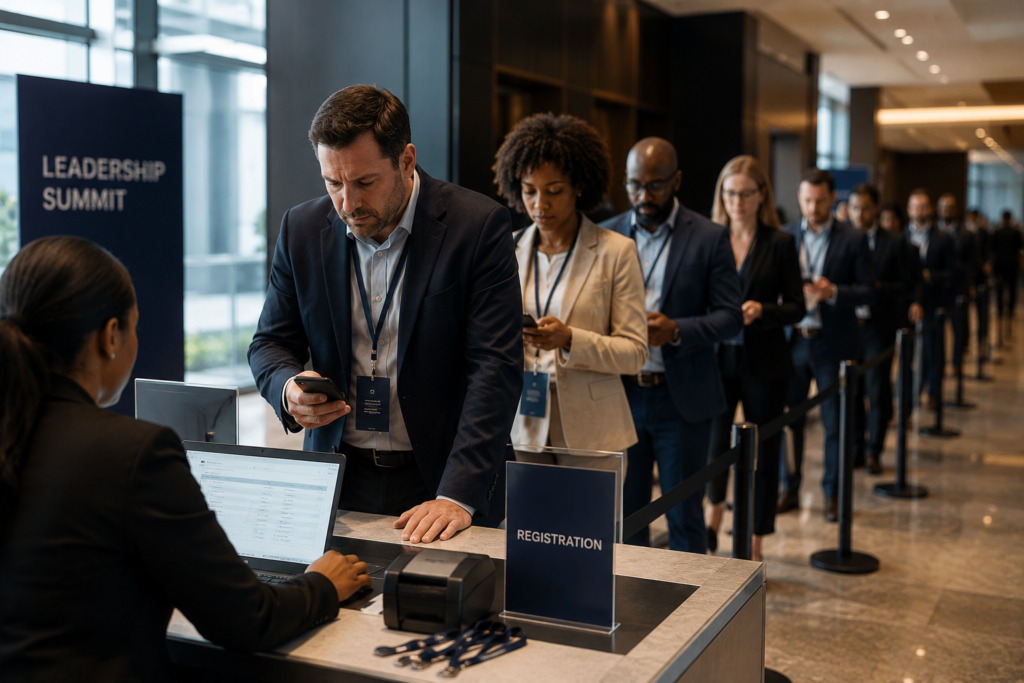
Attendance logistics is the system that ensures every guest:
- receives the right information at the right time before the event
- arrives at the right place with confirmed travel and accommodation
- moves through registration and accreditation without friction
- is tracked, confirmed, and accounted for throughout
It covers RSVP management, event website management, on-site check-in and accreditation, accommodation coordination, flight management, and transfer logistics.
Each of these functions has its own data requirements, its own communication touchpoints, and its own risk exposure. Managed well, they are invisible. Managed poorly, they become the story of the event.
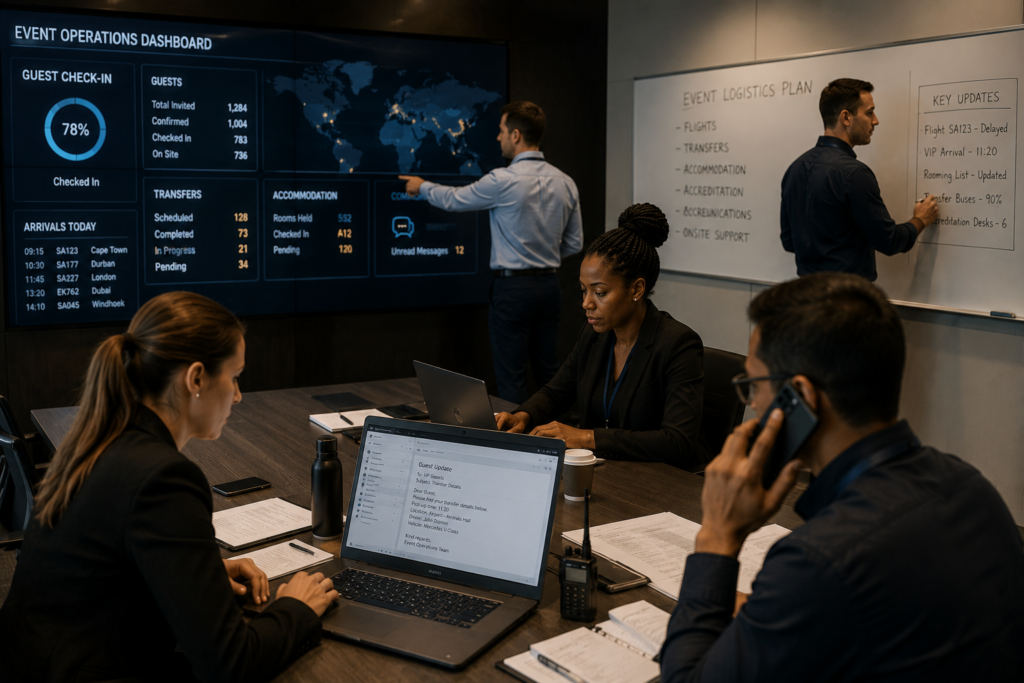
Why this is not the same as event administration
The distinction matters, and it is frequently misunderstood.
Event administration is broad. It covers everything from supplier invoicing to run-of-show documents to post-event reporting. Many event managers absorb guest-related tasks into this category, RSVP tracking as a line item, accommodation as a logistics task, transfers as something to sort out closer to the date.
But attendance logistics is not a set of tasks. It is a discipline with a specific risk profile.
Consider what is actually at stake:
- Guest data changes constantly, often days or hours before an event
- Multiple people contribute to and access the same information across email, spreadsheets, and booking systems
- Every inaccuracy has a downstream consequence, a missed dietary need, a wrong transfer time, a room allocation that hasn’t been updated
- The consequences are felt by guests, not by back-office systems
Attendance logistics is operational risk management. The risk is reputational, and the guest is the measure of whether it succeeded.
When a guest’s transfer is late, they don’t think ‘the logistics company made an error.’ They think ‘this event was disorganised.’ That perception attaches to the brand behind the event.
That is why the discipline of managing attendance cannot be treated as a background administrative function. It requires dedicated systems, ownership, and precision.
The scale of the challenge in South Africa
South Africa’s corporate events industry is not a niche market.
The South African MICE sector (Meetings, Incentives, Conferences and Exhibitions) was valued at approximately $6.6 billion (R121.8 billion) in 2023, and is expected to reach $25.9 billion (R477.9 billion) by 2032, this is according to an Allied Market research report. South Africa leads African MICE activity, contributing 32% of the continent’s events, with Johannesburg, Cape Town, and Durban as primary hubs.

These are not small numbers. They represent thousands of corporate events per year. These include conferences, incentive programmes, product launches, shareholder meetings, executive summits, each with its own guest list, its own logistics requirements, and its own reputational stakes.
For every one of those events, someone is responsible for making sure guests arrive correctly, are checked in efficiently, and are supported throughout. That responsibility is either managed with precision, or it is managed reactively.
The difference between those two approaches is what attendance logistics delivers.

What unmanaged attendance logistics actually costs
The cost is rarely a single catastrophic failure. It accumulates in smaller moments.
A corporate guest who queues for 20 minutes at registration has already formed an impression of the event before they have entered the room. A VIP whose transfer arrived 40 minutes late has spent that time wondering whether the rest of the day was going to be as poorly organised. A delegate who received three different versions of their accommodation confirmation has a diminished trust in the organisation behind the event.
None of these moments appear on the post-event report. They appear in conversations — in what guests say to each other, to their colleagues, and to the client whose brand was attached to the event.
The indirect cost of poor attendance logistics is reputational. And reputational damage in the corporate events space accumulates slowly and is recovered slowly.
How CARSAL approaches this
CARSAL Guest Liaison is a specialist attendance logistics partner for corporate events. We operate as the operational layer between event managers and their guests — managing the systems and coordination that keep the guest journey accurate, smooth, and professional.
We are not an event management company. We do not manage venues, production, creative direction, or programme delivery. We partner with event managers and agencies to take full ownership of the attendance logistics function so they can focus on delivering the event.

Our services cover the complete guest journey:
- RSVP management: invitation tracking, confirmation handling, attendance accuracy, change management
- Event website management: registration portals, information hubs, guest communication platforms
- On-site accreditation and check-in: registration desk management, digital check-in, arrival flow coordination
- Accommodation management: rooming list coordination, allocation management, special request handling
- Flight management: itinerary coordination, arrival and departure tracking, update management
- Transfer management: airport-to-venue coordination, movement scheduling, guest routing
Each service is managed with its own process, its own data standards, and its own communication protocols. Nothing is left to be ‘sorted out on the day.’

What this means for event managers
The event managers who manage attendance logistics best are not necessarily more capable than those who struggle with it. They are better supported.
When attendance logistics is handled by a specialist partner, something shifts in how an event team operates. The guest data is accurate and live. The transfers are confirmed and updated. The check-in system reflects the actual guest list. And when something changes at 11pm the night before, there is a system and a person responsible for managing it.
The event manager’s focus narrows to where it belongs: delivering an exceptional event for the client and the audience.
That is the operational case for treating attendance logistics as a distinct function — not because it is complex for its own sake, but because the guest experience depends on it being handled with precision.
The best corporate events don’t just run smoothly.
They run smoothly because someone made sure the guest list was clean, the transfers were timed, and the check-in system was ready before the first guest arrived.
That work is attendance logistics. And it deserves to be treated as exactly what it is.
CALL TO ACTION
Download our 5-point Guest Logistics Audit
A practical checklist covering RSVP accuracy, guest communication, transfer coordination, accommodation tracking, and check-in readiness. Use it before every event.